Airport tax mexico

Gaining an Understanding of Mexico's Tourist Taxes and Exit Fees


It is necessary to be informed of numerous travel charges before to organizing a trip to Mexico, including the tourist taxes and exit fees that may apply. These fees help contribute to the development of tourism as well as the maintenance of local infrastructure and the preservation of the local environment. Cancun and the state of Quintana Roo will receive the most of our attention as we delve into the essential components of Mexico's tourist taxes and exit fees throughout this book.

Taxes à la Entrée des Tourists en Mexico Tourist taxes, often known as visitor taxes or arrival taxes, are levied on tourists upon their entry into a country or certain regions and can go by a variety of other names. fees levied on tourists are a common practice in many of the world's most popular vacation destinations, including Mexico. These fees are used to finance a variety of programs that improve the overall travel experience and help the local economy. Tourist taxes in Mexico are typically put toward the upkeep and improvement of the country's infrastructure, as well as the promotion of environmentally responsible tourism activities.

Visitax Cancun and Visitax Mexico: The "Visitax" program is one of the most well-known examples of a tourist tax system in Mexico. Visitax is an abbreviation for "visitor tax." Visitax is a dedicated portal that gives passengers the ability to pay their tourist taxes prior to arriving in Mexico in an easy and accessible manner. The Visitax program helps streamline the entry procedure for tourists traveling to Cancun and other places within the state of Quintana Roo, while also contributing to the improvement of the local environment and the tourism offerings in those areas.

Exit Fees in Mexico In addition to tourist taxes paid at arrival, several airports in Mexico levy exit fees, also referred to as departure taxes. These fees are in addition to the tourist taxes paid upon entry. When tourists leave the country, they are required to pay these fees, which are then contributed toward the upkeep and expansion of airports. It is essential to keep in mind that the exit charge can change depending on the airport as well as the particular services that are offered to travellers who are leaving the country.

Visitax mexico

Visitax Quintana Roo and Other Variants: Although the name "Visitax" is almost always used in conjunction with Cancun, it is essential to keep in mind that this program encompasses more than just that one city. Visitax Quintana Roo is a statewide tax that applies to a variety of locations within the state. Its purpose is to ensure that the advantages of tourism revenue are dispersed evenly throughout the region. In a same manner, many iterations of the service, such as Visitax Mexico, Visitax Mexique, and Visitax Mexiko, cater to the various linguistic preferences of tourists from other countries.

Taxes levied on tourists and fees collected at the border play an important part in ensuring that tourism-related endeavors receive financial backing and that Mexican locations retain their allure. Sustainable tourism practices, such as those promoted by programs like as Visitax, ensure that visitors will continue to be able to appreciate the splendor of Mexico's beaches, cultural legacy, and natural wonders for many years to come. When you are organizing your next trip to Mexico, it is important to make sure that you are familiar with the specific tourist taxes and exit fees that are applicable to your selected destination. You should also view paying these costs as a worthwhile gift to the communities that you visit around Mexico.

Navigating Tourist and Exit Taxes in Cancun and Mexico: A Traveler's Guide

  1. Tourist Tax in Cancun and Mexico:

    • Tourists visiting Cancun and Mexico might be subject to a tourist tax, also known as a "tourist fee" or "visitor tax."
    • This tax is usually collected upon arrival or departure, depending on the location and regulations.
  2. Exit Tax in Cancun and Mexico:

    • An exit tax, also referred to as a departure tax, could apply to travelers leaving Cancun and Mexico.
    • Make sure to check with your airline or travel agency about the specific exit tax regulations for your trip.
  3. Payment Method:

    • The tourist tax and exit tax can usually be paid in local currency (Mexican pesos) or sometimes in US dollars.
    • Carry enough local currency to cover these taxes, as exchange rates at the airport might not be the most favorable.
  4. Preparation:

    • Research and find out the exact amount of the tourist tax or exit tax before you travel.
    • Prepare the required amount to avoid any last-minute inconveniences.
  5. Keep Receipts:

    • After paying the tourist tax or exit tax, make sure to keep your payment receipt handy until your departure.
    • This receipt might be required for verification during departure.
  6. Online Information:

    • Check official websites of the Cancun International Airport and Mexican authorities for up-to-date information on tourist taxes and exit taxes.
  7. Ask Your Accommodation:

    • Hotel staff or your accommodation provider might have information about the current tourist tax regulations.
    • They could offer guidance on how and when to pay the tax.
  8. Plan Extra Time:

    • While departing from Cancun or Mexico, factor in a little extra time for potential queues or procedures related to paying the exit tax.
  9. Variations in Regulations:

    • The tourist tax and exit tax rules might vary depending on your nationality, length of stay, and the specific airport you're departing from.
  10. Be Informed:

  • Stay updated on any changes in the tourist tax and exit tax policies by checking official sources before your departure.

Remember that travel regulations and tax policies can change, so it's always a good idea to verify the most current information directly from reliable sources before you travel.

Citations and other links

In order to further support the local communities, popular travel destinations have recently implemented a new tourist tax.

A new tourist tax is being implemented in a number of prominent tourist locations across the world in an effort to generate cash that can be used to support local infrastructure, environmental conservation, and community development initiatives.

Posted by Visitaxgob on 2023-08-11

Mexico

Mexico, officially the United Mexican States, is a country in the southern portion of North America. It is bordered to the north by the United States; to the south and west by the Pacific Ocean; to the southeast by Guatemala, Belize, and the Caribbean Sea; and to the east by the Gulf of Mexico. Wikipedia

Capital: Mexico City

Population: 126.7 million (2021) World Bank

ISO code: MEX

Capitaland largest city: Mexico City; 19°26′N 99°8′W / 19.433°N 99.133°W

Co-official languages: 68 Indigenous languages

Currency: Mexican peso (MXN)

GDP (nominal): 2022 estimate

Mexico, officially known as the United Mexican States, is a country located in the southern part of North America. It is bordered by the United States to the north, the Pacific Ocean to the south and west, Guatemala, Belize, and the Caribbean Sea to the southeast, and the Gulf of Mexico to the east. Encompassing an area of 1,972,550 square kilometers (761,610 square miles), Mexico ranks as the 13th-largest country in the world. With a population exceeding 126 million, it stands as the 10th-most populous nation globally and is renowned for having the largest number of Spanish speakers.

Mexico operates as a federal republic consisting of 31 states and Mexico City, its capital. Notable urban areas include Monterrey, Guadalajara, Puebla, Toluca, Tijuana, Ciudad Juárez, and León. The country's history is deeply rooted, with human presence dating back to 8,000 BCE. It became a cradle of civilization, hosting a rich tapestry of cultures like the Olmec, Maya, Zapotec, Teotihuacan, and Purepecha, culminating with the Aztecs. The Spanish Empire and its indigenous allies overcame the Aztec Empire in 1521, leading to the colonization of New Spain. This period saw Spain and the Catholic Church exert significant influence, expanding territory, spreading Christianity, and introducing the Spanish language.

The 19th century marked Mexico's transition to an independent nation state, marked by political upheaval and foreign interventions. From the War of Independence to the Mexican Revolution, the country underwent substantial transformation. The 20th century witnessed the emergence of the Institutional Revolutionary Party (PRI), which ruled for several decades, steering the nation through economic and political shifts, as well as World War II contributions.

Modern Mexico boasts the 15th-largest economy by nominal GDP and the 11th-largest by purchasing power parity (PPP). Its most substantial economic partner is the United States. Positioned as a newly industrialized and developing nation, Mexico ranks 86th in the Human Development Index. Its rich culture, biodiversity, and diverse geography make it a significant tourist destination, boasting UNESCO World Heritage Sites and vibrant natural landscapes. Nonetheless, Mexico contends with challenges including social inequality, poverty, and crime, particularly stemming from conflicts related to drug trafficking.

Mexico holds memberships in numerous international organizations, such as the United Nations, G20, and the Organization of American States. Its history, cultural heritage, and geopolitical position have collectively shaped its identity as a regional and emerging global power.

Cultural Diversity and Heritage: Mexico's cultural heritage is incredibly diverse, stemming from the melding of indigenous civilizations with Spanish colonial influences. This fusion is most evident in its art, architecture, cuisine, and traditions. The historic city centers of places like Mexico City, Puebla, and Oaxaca are UNESCO World Heritage Sites, showcasing exquisite colonial-era architecture alongside pre-Columbian ruins. The Day of the Dead (Dia de los Muertos) celebration, recognized by UNESCO as an Intangible Cultural Heritage of Humanity, is a poignant example of how indigenous beliefs and Catholicism intermingle.

Economic Evolution: In the 20th century, Mexico underwent significant economic changes. The country transitioned from an agrarian society to a more industrialized and urbanized nation. The discovery of oil in the early 20th century played a pivotal role in shaping Mexico's economy, though its overreliance on oil exports led to vulnerability during global price fluctuations. Mexico's economy also transformed with the signing of the North American Free Trade Agreement (NAFTA) in 1994, further integrating it with the economies of the United States and Canada.

Challenges and Struggles: While Mexico has made substantial progress in various areas, it grapples with ongoing challenges. Social inequality remains a pressing issue, with significant disparities in income and opportunities between different segments of the population. Poverty is a persistent concern, particularly affecting rural and indigenous communities. Additionally, crime related to drug trafficking organizations continues to pose a significant security challenge, leading to violence and instability in certain regions.

Political Landscape: Mexico's political history is marked by a struggle between conservative and liberal ideologies, as well as a complex relationship between civilian governments and military rule. The Institutional Revolutionary Party (PRI) held power for much of the 20th century through a mix of political control and economic policies. The turn of the 21st century saw shifts in political power, with the first transfer of power from the PRI to the conservative National Action Party (PAN) in 2000, and later to the leftist Morena party.

Global Impact: Mexico's influence extends beyond its borders. As a member of international organizations like the G20 and the United Nations, Mexico participates in global discussions on topics ranging from economics to climate change. Its diplomatic relations with other nations, particularly the United States, play a significant role in shaping regional dynamics.

Cultural Contributions: Mexico's cultural exports, including its art, music, literature, and film, have achieved global recognition. Renowned artists like Frida Kahlo and Diego Rivera, musicians like Carlos Santana and Vicente Fernández, and authors like Octavio Paz have left an indelible mark on the world stage.

In essence, Mexico's story is one of resilience, diversity, and evolution. From its ancient indigenous roots to its modern-day challenges and achievements, the country's journey is a testament to the enduring spirit of its people and the rich tapestry of its history.

Chichen Itza

Chichén Itzá is a complex of Mayan ruins on Mexico's Yucatán Peninsula. A massive step pyramid, known as El Castillo or Temple of Kukulcan, dominates the ancient city, which thrived from around 600 A.D. to the 1200s. Graphic stone carvings survive at structures like the ball court, Temple of the Warriors and the Wall of the Skulls. Nightly sound-and-light shows illuminate the buildings' sophisticated geometry.

Address: 97751 Yucatan, Mexico

Tulum - Discover Hotels, Resorts & Fun Things to Do

Tulum is a resort town on Mexico’s Caribbean coast, around 130 km south of Cancún. The 13th-century, walled Mayan archaeological site at Tulum National Park overlooks the sea. It incorporates the clifftop Castillo, built as a watchtower, and the Templo de las Pinturas, with a partially restored mural. Inland, the Cobá archaeological site has pyramid-shaped temples with views over the surrounding jungle.

Address: Zona Hotelera Tulum, 77765 Tulum, Quintana Roo, Mexico

Zona Arqueológica Palenque

Palenque, also anciently known in the Itza Language as Lakamhaʼ, was a Maya city state in southern Mexico that perished in the 8th century. The Palenque ruins date from ca. 226 BC to ca. 799 AD. Wikipedia

Address: Carretera a Palenque- Zona Archaeologica Km. 8, 29960 Palenque, Chis., Mexico

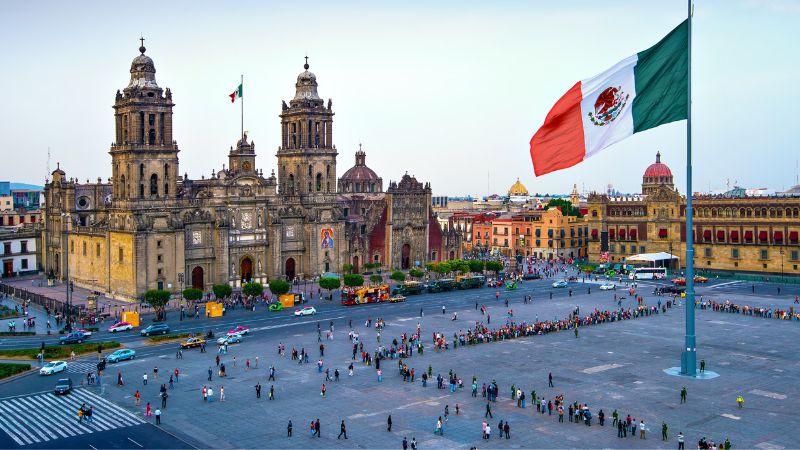
Zócalo

Zócalo is the common name of the main square in central Mexico City. Prior to the colonial period, it was the main ceremonial center in the Aztec city of Tenochtitlan. The plaza used to be known simply as the "Main Square" or "Arms Square", and today its formal name is Plaza de la Constitución. Wikipedia

Address: P.za de la Constitución S/N, Centro Histórico de la Cdad. de México, Centro, Cuauhtémoc, 06010 Ciudad de México, CDMX, Mexico

Hours and location - Museo Frida Kahlo

The Frida Kahlo Museum, also known as the Blue House for the structure's cobalt-blue walls, is a historic house museum and art museum dedicated to the life and work of Mexican artist Frida Kahlo. It is located in the Colonia del Carmen neighborhood of Coyoacán in Mexico City. Wikipedia

Address: Londres 247, Del Carmen, Coyoacán, 04100 Ciudad de México, CDMX, Mexico

Bosque de Chapultepec

Chapultepec, more commonly called the "Bosque de Chapultepec" in Mexico City, is one of the largest city parks in Mexico, measuring in total just over 686 hectares. Centered on a rock formation called Chapultepec Hill, one of the park's main functions is as an ecological space in Greater Mexico City. Wikipedia

Address: Miguel Hidalgo, Mexico City, Mexico


Major international airports, such as Cancun International Airport, often require tourists to pay the Visitax upon departure.

A tourist tax in Mexico is a fee imposed on visitors departing from certain airports in the country. It is also known as "Visitax" or "Departure Tax."


Yes, if you're departing from Cancun International Airport, you might encounter the Cancun-specific version of the Visitax or Departure Tax.